


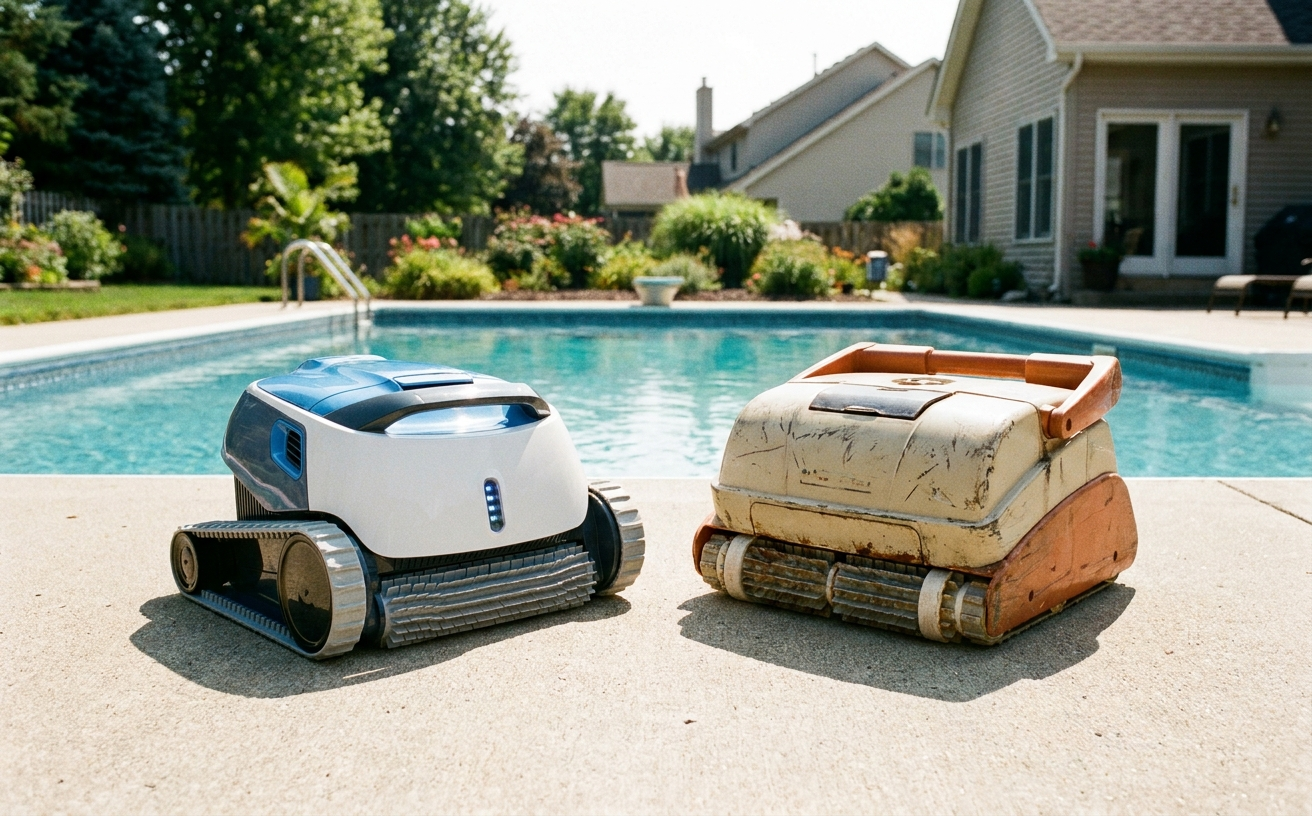
If you bought a robotic pool cleaner in 2020 and it is still running today, you are in the minority. Most machines from that era have already been replaced. The units shipping in 2026 are built differently, and the differences are not cosmetic. They address the specific failure points that caused earlier models to die prematurely.
Understanding what changed helps you evaluate whether a newer design is worth the investment, or whether you are paying for features that do not affect reliability.
Sealed Drive Motors
The single most common failure point on older robotic cleaners was the drive motor. Water would seep past the shaft seal, corrode the bearings, and seize the motor. The failure was gradual: the cleaner would slow down, start clicking, and eventually stop moving on one side.
Modern designs use sealed can motors where the entire motor assembly is enclosed in a waterproof housing with no shaft seal. The motor connects to the drive wheel through a magnetic coupling that transmits torque through the housing wall without any physical penetration. Water cannot reach the motor because there is no opening for it to enter.
Improved Cable Jackets
The cable on a robotic pool cleaner operates in a harsh environment. It is submerged in chemically treated water, exposed to sunlight, flexed repeatedly, and occasionally pinched between the cleaner and pool features. Older cable jackets used standard PVC that became brittle after two to three seasons of UV exposure.
Current models use cross-linked polyethylene jackets that resist UV degradation, remain flexible across a wider temperature range, and resist cracking from repeated flexing. The difference in cable longevity is dramatic. Older cables typically failed within three years. Current cables routinely last five years or more.
The internal conductor configuration has also improved. Older cables used solid conductors that fatigued and broke at flex points. Newer cables use stranded conductors that distribute stress across multiple wires, preventing single-point fatigue failures.
Modular Component Design
When a motor failed on an older cleaner, replacing it required disassembling the entire machine. The motor was integrated into the frame, connected to the drive system with hard-wired connections, and sealed with adhesive that made removal difficult. Many owners replaced the entire machine rather than attempt the repair.
Newer designs use modular components that snap or bolt into place. The drive motor is a cartridge that slides out after removing two or three fasteners. The pump module is a separate unit that can be replaced without opening the main housing. Cable connections use plug-in terminals rather than soldered joints.
Modular design does not make the machine more reliable, but it makes repairs faster and cheaper. A motor cartridge replacement takes fifteen minutes and costs a fraction of a new machine. This extends the practical life of the cleaner because owners are more likely to repair than replace.
Top-Access Filter Systems
Top-access filters were available five years ago but were premium features. Most cleaners required flipping the machine over to access the filter, which discouraged regular cleaning. Owners who found the process unpleasant simply left the filter in the machine, which led to reduced suction and motor overheating.
Top-access is now standard on most models because manufacturers recognized that filter cleaning frequency is the single biggest factor in cleaner longevity. A cleaner with an easy-access filter gets cleaned after every use. A cleaner with difficult access gets cleaned sporadically.
The relationship between filter access and machine life is indirect but powerful. Clean filters allow full water flow, which keeps the pump motor cool. Cool motors last longer. The path from convenient filter access to extended machine life runs through human behavior: easy access leads to regular cleaning, which leads to better cooling, which leads to longer motor life.
Better Thermal Protection
Older cleaners had basic thermal cutoff switches that shut the motor down at a fixed temperature. The switch protected the motor from immediate damage but did not prevent the repeated overheating cycles that degraded the motor winding insulation over time.
Current models use variable thermal management that reduces motor speed as temperature rises, rather than waiting for a critical threshold and shutting down completely. This approach keeps the motor in a safe operating range under all conditions and prevents the thermal cycling that shortens motor life. In any 2026 pool cleaner comparison, this thermal management approach is a meaningful differentiator that affects long-term reliability.
The practical benefit is that modern cleaners can run longer cycles without overheating, which means they cover the pool more thoroughly in a single session. For large pools that previously required two cycles, the improved thermal management often allows full coverage in one.
What Has Not Changed
Some aspects of pool cleaner design have not improved meaningfully. Cable tangling remains an issue on all but the most expensive models with active swivel connectors. Wall climbing capability varies widely between models and has not improved as a category. Filter capacity is still the primary constraint on cleaning time.
These are engineering challenges that have proven difficult to solve without significant cost increases. The improvements that have been made — sealed motors, better cables, modular design, improved thermal management — address the failure points that caused the most customer dissatisfaction and warranty claims.
The result is a generation of cleaners that are genuinely more durable than their predecessors. Not because of marketing claims or specification improvements, but because the specific components that failed most often have been redesigned to eliminate the failure modes. That is progress that shows up in years of service rather than on a feature list.
Leave a Reply